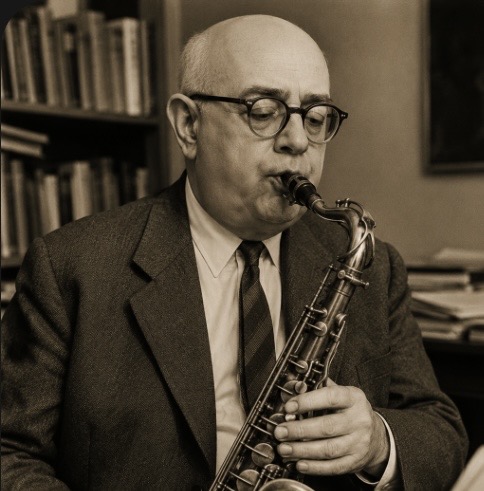
All right. I’ve read some of those ‘controversial’ writings by Teddy on ‘jazz’ now, and I think perhaps what we’ve had here is a simple misunderstanding…
If you recall the era and the context in which the old boy was writing, you see at once that what Teddy is on about is the mid-20th century emergence of a then-new-technology-enabled, mass-media-mediated ‘pop culture.’
The latter seems at the time to have been, and seems even now to remain, little more than a submarket that underwrites (i.e., functions as ‘substructure’ for) much of that ‘superstructure’ which is the ‘mass culture’ produced by ‘late capitalism.’
This has of course been, since Teddy’s day, a ‘culture,’ ‘produced’ by a ‘culture industry,’ which like everything produced under capitalism is produced in the form of commodities for exchange.
The ‘for’ here is all-important. Production for exchange is radically, qualitatively different from production solely for use (or expression, or communication, or …). And where the production is qualitatively different, so is the product.
In this context, it is no accident that Teddy is writing about the then-new mass media of radio (mid-1930s), then television (early-1950s), at the same time that he’s writing about what he called ‘jazz.’
It’s also no accident, given all of this, that in speaking of ‘jazz’ Teddy refers often to the then-popular, homogenized commodity ‘jazz’ of the ‘big band’ variety then being proffered by the likes of Benny Goodman’s band, Paul Whiteman’s ‘orchestra,’ and the like – stuff widely heard on the radios, then televisions, of Teddy’s day.
What Teddy says about this ‘product’ does not seem way off or implausible – especially coming, as it does, from the pen of a renowned music theorist and accomplished musician who studied under Schoenberg.
That ‘big band’ stuff was quite predictable and parameterized, if not indeed scored and scripted, even in its putative ‘improv’ moments. And its rather flattened would-be syncopations DO seem derived from military marches as Teddy suggested (maybe that accounts partly for this stuff’s popularity among soldiers during the Second War?).
Just give it a listen. Google ‘big bands’ and read Teddy while THAT stuff is streaming. Tatum or Monk, Evans or Miles or Trane it just ain’t.
Teddy’s writings here will ring even MORE true to the contemporary reader, I submit, if you imagine him writing of ‘pop music’ now rather than ‘jazz’ (the ‘pop’ of his day) back then. Nearly all of the current stuff is now generated by algorithms – most of them coded, for G-d knows what reason, in Sweden. (I’m not kidding. Sweden, the land of my grandparents, known for its spontaneity as Paul WHITEman was known for his drip and his dope.)
Compare almost any current pop to, say, the notoriously painstaking craftings of a Tom Waits or Don van Vliet, and you might find yourself agreeing that Teddy had a point.
This isn’t to say, stuffed-shirt style, that the popular stuff isn’t often quite pleasant, even brilliantly written and deeply affecting. (I confess that I love ‘Taylor,’ ‘Billie,’ and ‘Lola,’ for example.) of course it is.
But Teddy’s point simply is that this stuff is now programmed to be such, just as we are now programmed to like it.
Which is precisely why I’ll always love Shannon’s stuff more.


Leave a Reply