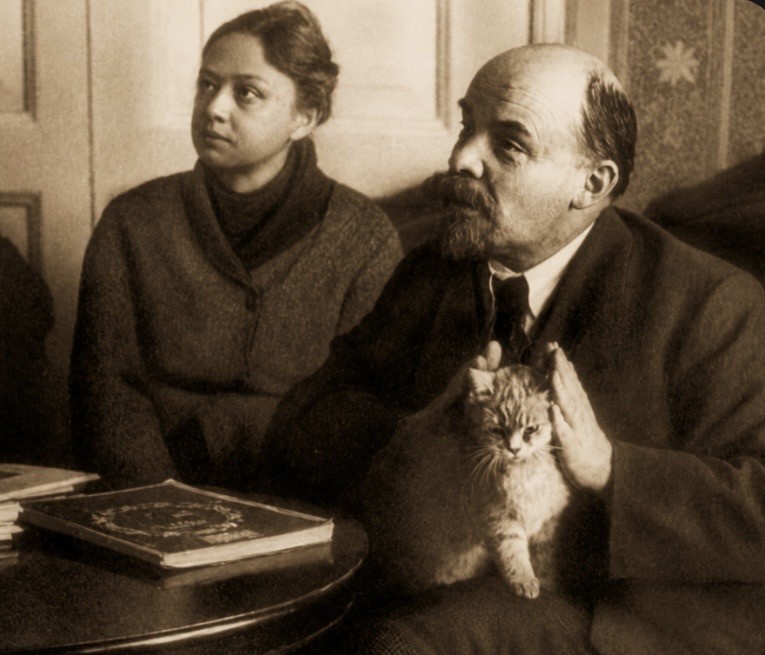
I hesitate to disturb Lenin’s posthumous sleep, because doing so could elicit exactly the kind of behavior I intend to deplore. But what the hell, an argument that ‘shows’ through its responses what it ‘says’ through its content might just ‘stick’ better than one with just one dimension.
So here’s the behavior in question …
A certain kind of argument – or perhaps better, an argument-substitute – seems to occur with some frequency on platforms like this one. The form of the type in question is as follows:
‘But what you are saying here is also said by this person who also says χ,’ or ‘… who is allied with α,’ where χ represents some claim other than the one at issue, and α represents some person or institution that herself or itself has said things like χ.
A closely related version of this ‘argument’-form fixates not on who or what you in effect AGREE with, but on who you in effect DISAGREE with. So your interlocutor will say something like ‘but α is on the other side on this one,’ without ever addressing what α actually says let alone engaging with its merits or, independently, with the merits of what YOU say. At most you will hear ‘and α is a distinguished authority!’
A few examples from (my) ‘real life’ might help fix intuition…
(1) I recently ‘shared’ a helpful and noncontroversial informational post by someone I don’t know well. A pseudo-left edge-lord leapt in indignantly and said, ‘have you seen this guy’s page?!’ I hadn’t. Nor did – or do – I GAF.
(2) I recently wrote and posted a piece on hamas’ Duchampian-readymade, ‘palestinianist’ pseudo-identity that went viral. An apparently reactionary edge-lord complimented the post, then angrily demanded I clarify whether I ‘still think Israel is oppressing the Palestinians.’ Huh? Apparently he was fixating on something said last autumn by a co-author of mine, born in the Bergen-Belsen camp, who ironically is one of Israel’s most prominent international lawyer defenders.
(3) Someone cited me favorably in the Comments section of a fellow Marxian’s post. A pseudo-left edge-lord said ‘but he shared something from Free Press, which was founded by Bari Weiss.’ (Bari Weiss – baaaaad.) He probably meant leftwing atheist Sam Harris’s superb recent piece on Zionophobe psychosis, which I have indeed gratefully shared widely and cannot recommend too highly to any of you reading my words right now. This post had no relation at all to the subject under discussion in the mentioned post’s Comments section.
(4) During the Wall Street Occupation I was working at the New York Fed (FRBNY) each day and camping at Zuccotti Park just a few blocks away every night. Some colleagues and I founded the OccupyMoney Cooperative – a nonprofit credit union available to all – during this time. In a webchat group that we set up to address questions someone said, ‘I’ve looked up this Hockett guy and he works at the Fed so this must be a bad idea.’ Note that FRBNY also published my eminent domain plan for city seizures and write-downs of underwater mortgages, which got both it and me pilloried as commies by the WSJ OpEd page three times in one week. (Google it.)
See what I mean?
These are of course all of them variants on the familiar argument ad hominem, which is both widely known and well understood to constitute an insipid fallacy. Yet variations on it seem to be so common on platforms like this one that I think it will nevertheless be worth (a) drawing out the precise SENSES in which they are fallacious, and (b) conjecturing as to WHY they’re so COMMON here.
As to the senses in which they’re fallacious, three in particular strike me as salient right now.
The first is that a claim or an argument to which you object ought to be rebuttable on its own evidentiary and logical merits if your objection is actually cognizable and hence intelligible to reason, rather than simply being unpleasant or ‘a bad vibe.’ You simply shouldn’t have to bring others into the argument.
There are ‘inconvenient truths,’ after all, as well as truths carried by unpopular or contrarian claims, and only very young children or very stunted adults treat them as falsehoods on that account. They must be shown or found false on their OWN account, else we’re not deploying the notions of truth or falsehood at all, but instead engaged in some other activity.
Second, as to the χ-form above, unless there is some logical entailment relation between χ and the claim to which one objects (‘it can’t be right because that would mean Sappho, a woman, is immortal; and no woman or man is immortal’), then someone else’s affirming or denying of χ is simply not relevant to the truth of the claim that’s at issue.
S/he who offers the χ-form claim, then, as an ‘argument’ against the putatively objectionable claim is not arguing at all. S/he is what I’ll call substitute-arguing. I will return to this momentarily.
Finally third, as to the α-form above, here there are TWO reasons we don’t have an argument at all…
The first carries over from the case of the χ-form substitute-argument: if who one has associated with or agreed with or disagreed with on this or that matter on this or that occasion has no logical entailment relation to a claim that s/he makes, then one is not engaging with the CONTENT of the claim AT ALL in pointing to the previous association as somehow damning, discrediting, or ‘gotcha-ing’ (‘aha!’).
And so one is not engaged with the cognizable matter at issue. One is instead ‘going Pavlov,’ as I sometimes say, offering a Pavlovian association in lieu of a logical relation, between claim and putative counterclaim. That isn’t arguing or truth-seeking, it is ‘identifying.’
The second reason that the α-form response isn’t an argument is that people regularly approve of or associate with other people and institutions for ALL MANNER of reason and all manner of PURPOSE. You might agree with me on literally only one matter and disagree on all else. Or you might ‘like’ or refrain from ‘liking’ something I post for any number of reasons, including only briefly applicable ‘strategic’ or ‘tactical’ reasons, at any given moment.
In this sense, the sundry ‘associatings’ appealed to in this style of argument-substitute not only ARE logically independent of the merits of claims actually at issue, but might not even be INTENDED to be OTHERWISE.
It is thus worse than absurd, it is comically childish, for any adult to purport to ‘argue’ with someone on the putative basis that she either has, or has ‘liked’ or associated with someone or some other entity that has, ‘liked’ or associated with some other person or entity that, again, is not herself or itself the matter at issue. This is, again, not argumentation, but substitute-argumentation.
All right so it seems to me this is all pretty obvious. Why then is behavior conducted in complete disregard of it so rampant? Why are so many of us rank sophists – or, worse, idiots – now?
I am guessing it has something to do with the ‘herding’ and ‘sides’-forming that mass-‘conversation’ platforms like this one encourage. For when ‘choosing sides’ or ‘forming teams’ becomes the dominant social dynamic, and when the categories of ‘in-group’ and ‘out-group’ accordingly emerge as compelling or are felt as in some sense ‘important,’ it is ‘natural’ in a certain sense for them to grow ‘front-of-mind’ in our interactions.
And so THEN what might jump out first at you upon encountering somebody’s ‘post’ or their ‘like’ is what this seems to indicate about ‘what team they’re on,’ what their ‘tribal identity’ is, rather than how actually sustainable or otherwise on the merits – how provable or disprovable – their assertions are.
All of this is in a certain sense cute and forgivable. It is so HUMAN, after all. But it’s also a bit infantile – we are ‘cute’ and ‘adorable’ insofar as we’re childlike, after all. And that can be harmful or at least counterproductive in adult situations.
I suspect this is what lay behind Lenin’s excoriation, as ‘infantile disorder,’ of a certain brand of what he called ‘leftwing communism’ – whose priggish insistence on ‘purity’ prevented all progress when all who might otherwise have UNITED on COMMON causes, in order ACTUALLY TO PROGRESS, instead simply paralyzed one another perpetually with bickering and casuistic squabbles.
Is that what is happening here? Well I suppose it depends on just what we are doing here and why we are doing it – in particular, on whether we’re trying to ‘progress’ in some way.
I tend to assume that we ARE here to do that – that there is a teleology to this ‘space.’ The relevant telos, in turn, I have assumed to be: the truth of the matters that we here discuss.
If I am right about that, then all of the foregoing – that is, this post – had a purpose and might even have served as a helpful reminder that is at least ‘helpful at the margin.’
If I am wrong, though, then it’s all been a waste of time, and I should probably just stick to pretty pictures, announcements, and cat videos.


Leave a comment