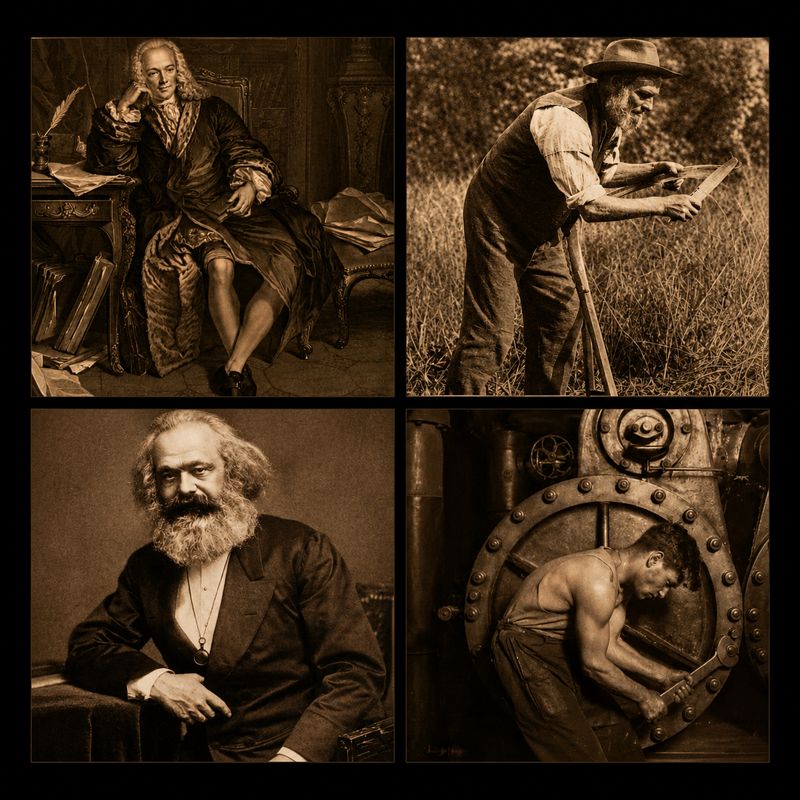
A crucial bit of social self-understanding we owe in part to the early Edinburgh school of political economy, especially Steuart and Smith, is that some classes of modern society live on material surplus generated by other classes of society. Smith in particular highlit the landed gentry, royal families, and clerical establishments (vide the Churches of England and Scotland) of his day as examples of high status minorities whose names everyone knew, who effectively rode on the backs of much larger majorities of socially ‘nameless’ people consigned to toiling in obscurity.
Marx, who gladly acknowledged that he himself stood on the shoulders of French and British precursors (especially but not exclusively Smith and Ricardo) where political economy was concerned, deepened and broadened – in a word, RADICALIZED, in the original Latin, ‘down to the roots’ (‘radix’) sense – the critique in both (a) rigorously tracing social surplus back to its origin as surplus LABOR (labor in excess of that required for mere subsistence), and (b) explicitly exposing how many ADDITIONAL ‘aristocracies’ and ‘priesthoods’ in modern societies live on that ultimately labor-generated surplus. Among these additional aristocracies are the society’s lawyers and legislators. And among the additional priesthoods are the society’s academics – people like Smith himself.
It accordingly seems to me that those of us holding these characteristically modern positions – positions from which Marx himself, thanks to his actually consequential and hence actually ‘dangerous’ radicalism was barred – hold them in trust. We are custodians of the surplus, ultimately answerable to the generators of this surplus which makes our roles possible – viz. the surplus-producers who enable our society’s particular ‘division of labor’ and spare us in ‘high office’ the task of ’tilling the soil’ ourselves and contributing materially rather than just intellectually to the common weal.
For this reason, in turn, it seems to me we should be able to say with straight face and no ‘special pleading’ how our work contributes to that common weal, and in particular how it stands to benefit those generating the material surplus on which we all live. We shouldn’t be about our names or our ‘brands’ as the aforementioned parasitic peerage identified by Smith was. We should be about the nameless who are ultimately entrusting us with thinking-through how we might all of us better arrange our common affairs – a task that those good at abstract thinking have been delegated by those surplus-generators in whose service this abstract thought should proceed. Anything less, it seems to me, is sheer parasitism.
None of this, it should go without saying, is to say that there ought to be some kind of ‘official enforcer’ of the foregoing ‘oughts’ and ‘shoulds.’ Norms of free inquiry and academic freedom all stem, I assume, from wide recognition that the long-term value or usefulness of abstract speculation, ‘thought-experimenting,’ and lab-experimenting are difficult to know in advance, hence best ‘bet on’ by broad groups of democratically deliberating, qualified peers. But I do think one corollary of these norms is that we must remain mindful of that word ‘qualified”s vulnerability to self-serving gerrymandering and complacency. And one means by which we can combat that danger, I think, is precisely by keeping continually in mind Smith’s and Marx’s SURPLUS-generators, who are not wearing KKK-style face coverings or waving fake foreign flags, and to whom neologisms like ‘ontologize’ likely mean nothing, not something.


Leave a comment