An embarrassingly common mischaracterization of Marx, made almost exclusively by people who haven’t actually readMarx, amounts in effect to a grammar school syllogism whose premises are false and whose conclusion in any case wouldn’t follow:
(1) Marx propounded a ‘labor theory of value’ (LTV) that was essentially that of ‘the British School’ of political economy, primarily as represented by Smith and Ricardo;
(2) The British School LTV was essentially an early version of what today is called Price Theory, attempting to explain market prices exclusively by reference to Lockean ’embodied labor’;
(3) By transitivity, (1) and (2) jointly entail that Marx’s Kapital, where his LTV was developed, was meant to be a contribution to Price Theory – an attempt that, alas, was rendered obsolete shortly before Marx’s death by the (yet again British) Bentham-inspired ‘subjectivist’ accounts that became dominant with the onset of the ‘Marginalist Revolution’ led by Menger in the Germanophone world, Walras in the Francophone world, and Jevons in the Anglophone world from the 1870s onward.
This is of course utter nonsense, as anyone who actually reads Marx, and especially anyone who knows the essentially Hegelian-interpretive nature of Marx’s ‘project,’ learns very quickly. The real ‘keys’ to the role that the concept of value plays in Marx’s effort to grasp the essence of capitalist society are: first, Marx’s notion of ‘surplus value’; and second, Marx’s notion of the ‘value-bearing’ commodity as ‘fetish’ in capitalist society’s mode of self-understanding, especially as manifest in its self-interpretive discipline known as ‘political economy.’
As to the first of these, I’ve written a fair bit on the three volumes of Kapital and its ancillary ‘fourth’ volume, the massive and marvelous Theories of Surplus Value (TSV), as elaborating what I call a ‘social aggregates’ approach to understanding production and circulation under capitalism – an approach that enables us to see very clearly what our big Social Production Machine does, how it does it, and how it can be adjusted to do it pretty much infinitely better. (The giant on whose shoulders we all stand here is the wonderful Fred Moseley, more on whom below.)
The social surplus that Bataille called ‘the accursed share’ then, I have argued, can with this understanding be made into a genuine blessing for the earth and all of its inhabitants. Anyone interested in this line of thinking can navigate over to CapitalFutures or TheDiagonal for more on what I sometimes call the ‘Bataillean’ aspect of Marx’s massively fruitful achievement.
As to the second key that I mention to what Marx had in mind by ‘value’ – his discussion of the ‘fetish’ character of the capitalist commodity – well, much as with ‘value’ itself, so here the mere casual is apt to fall into a deep shallowness-trap. Marx was not offering some novel or pioneering anthropological account of ‘modern idolatry’ or ‘the worship of mere lifeless objects’ in the commodity-fetishism section (Section 4) of Kapital Vol. I’s very first chapter. Rather, what he was doing was following his mentor Moses Hess in drawing out how, in attributing market-manifest ‘value’ to tradable goods and services under capitalism, we are often non-cognizantly using a form of shorthand…
In speaking of the ‘values’ of such things we are speaking of what we have put in to them – our time spent laboring, that which generates the above mentioned social surplus, along with our social subsistence. And we’re accordingly speaking, derivatively, of our working relations to one another in the big social production process, the ‘Big Social Production Machine’ that I mentioned above.
In highlighting this fact and elaborating its virtual inescapability under capitalism, Marx wasn’t ‘criticizing’ in any ‘moralizing’ sense. He was critiquing, in that sense so familiar to nearly all German philosophical thought from Kant down through Hegel to later Frankfurt School ‘Critical Theory’: he was interpreting. Many continue to do so today, probably not knowing they’re channeling Marx on commodity-fetishism in so doing. You hear it any time you hear people use words like (Radinesque) ‘commodification,’ ‘objectification,’ or (Lukácsian) ‘reification.’
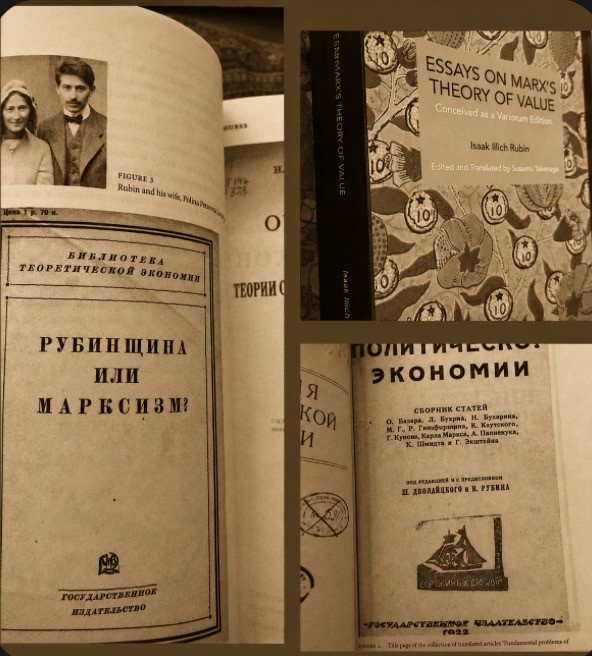
It is in this connection – the ‘value’ as key to capitalist self-understanding connection – that I want to recommend the new publications to which I refer in the title of this post…
Many devotees of Marx’s Hegelianism hold a special place in their hearts for the early Soviet thinker Isaak Rubin’s Essays on Marx’s Theory of Value, the first edition of which was published in 1923, while Lenin was still nominally leading the Soviet Union (he died the following year). Certainly nobody of whom I am aware has come anywhere close to understanding, and drawing the implications of, the things I have hinted at here as well as did he – not even the contemporary ‘Value Form’ theorists inspired by, and still nowhere near as penetrating as, Rubin himself was.
Most of us who have known Rubin only in English translation, in turn, have known him only through a rather slim volume of some of his essays – typically the second edition. Now, however, one of my informal mentors – the aforementioned Fred Moseley – and Susumu Takenaga are wrapping up a trilogy of volumes that include both all of Rubin’s work on the one hand, and multiple takes on that work by the most dedicated value-theorists of the present day on the other hand.
The first volume in the trilogy, at nearly 1000 pages in length, is a much larger fourth edition of the aforementioned Essays, supplemented by other pertinent writings of Rubin’s. It has just arrived at my doorstep. It accordingly looks as if I will be busy for a while.
The second two volumes in the trilogy are on their way. So I guess I’ll be busy for yet longer.
If you too are a Rubin enthusiast, but didn’t know of this update to the Anglophone Rubin corpus, please consider reading along!
And if you’re not yet a Rubin enthusiast, please consider taking a look! Especially if you often find yourself using such words as ‘commodify,’ ‘reify,’ or ‘objectify’ and are not yet acquainted with their rich and instructive conceptual genealogy.
Rubin on Marx on Value


Leave a Reply